Oeuvres d'Art du Pavillon Anglais / Works of Art from the British Pavilion

Paris 1900 - Arts, design, fashion, shows
Avatar du membre
worldfairs
Site Admin
Messages : 12084
Enregistré le : 21 juin 2004 09:41 pm
Contact :

Oeuvres d'Art du Pavillon Anglais / Works of Art from the British Pavilion

Message par worldfairs »

Extract of book "The Royal Pavilion - Paris International Exhibition, 1900"

In the Entrance Hall

Above the dado were the splendid set of Launcelot tapestry panels, designed by Sir E. Burne-Jones, and woven b}' William Morris, which were greatly admired by French artists. These panels represent scenes from the Arthurian legend of “The Quest of the Holy Grail," namely, “The Knights at Table,” “The Knights Departing," “Sir Gawaine,” and “Sir Launcelot,” and were lent by Mr. George McCulloch. The practice of this kind of weaving was virtually obsolete in England when, some twenty years ago, William Morris commenced a revival of this beautiful and effective decorative art, and produced many other fine panels, also from designs by Burne-Jones. Of all kinds of wall decoration, Arras tapestry is the most durable, except mosaic, and the most desirable, next to painting b}' a great master, but as a mechanical art it has made little or no progress, its method of manufacture being precisely the same now as it was in Flanders in the Middle Ages.

The stained glass windows were also-by William Morris, but they did not display any specially artistic character. A silver chandelier, copied from one at Knole, was suspended from the ceiling; a handsome table of the period, and a state chair of Scottish workmanship, completed the furniture of the Hall. A few pieces of English armour of the latter half of the sixteenth and first half of the seventeenth centuries were lent by Mr. Seymour Lucas, R.A.,and helped to decorate the walls. They consisted of Pikeman's demi-suits and suits of blackened steel, together with a collection of bills, glaives, partisans, halberds, swords, etc. The metal work, both here and in other parts of the Ro3ral Pavilion, must be specially mentioned. It was excellent both as regards design and workmanship, as were also the specimens of the art of enamelling on metal which were to be seen in handsome fire-dogs in several rooms.

The Knights at Table. Tapestry Panel<br />By Sir E. Burne-Jones
The Knights at Table. Tapestry Panel
By Sir E. Burne-Jones

The Knights Departing. Tapestry Panel.<br />By Sir E. Burne-Jones
The Knights Departing. Tapestry Panel.
By Sir E. Burne-Jones

Sir Gawayne. Tapestry Panel.<br />By Sir E. Burne-Jones
Sir Gawayne. Tapestry Panel.
By Sir E. Burne-Jones

Sir Lancelot. Tapestry Panel.<br />By Sir E. Burne-Jones
Sir Lancelot. Tapestry Panel.
By Sir E. Burne-Jones

Avatar du membre
worldfairs
Site Admin
Messages : 12084
Enregistré le : 21 juin 2004 09:41 pm
Contact :

Re: Oeuvres d'Art du Pavillon Anglais / Works of Art from the British Pavilion

Message par worldfairs »

Extract of book "The Royal Pavilion - Paris International Exhibition, 1900"

In the Saloon

“ Laus Veneris ” represents a Queen in orange drapery with her crown on her knees. Four of her maidens are preparing to sing a chant in praise of Venus from an illuminated music book. The tapestry background represents the birth and triumph of Venus, and through a window are seen five knights riding.

Laus Veneris<br />By Sir E. Burne-Jones
Laus Veneris
By Sir E. Burne-Jones


“St. George.”—The saint is represented as a full-length figure in armour, holding a banner and shield, on which is represented the Princess Sabra in the coils of the dragon. At the saint's feet are the dragon and his helmet, and in the distance are rocks and trees.

St. George<br />By Sir E. Burne-Jones
St. George
By Sir E. Burne-Jones


“ Angel of the Martyrs."—This picture is the development of a design originally made for a stained glass window in Christ Church, Oxford, and represents one of the two angels who, in the original design, support St. Cecilia, the central figure. It is dated 1874.

Angel of the Martyrs<br />By Sir E. Burne-Jones
Angel of the Martyrs
By Sir E. Burne-Jones


“The Delphic Sibyl." or, as it was formerly known, “The Delphine Sibyl,” was also originally designed for a glass window in Jesus College Chapel, Cambridge, in 1873.

The Delphic Sibyl<br />By Sir E. Burne-Jones
The Delphic Sibyl
By Sir E. Burne-Jones

" Cupid and Psyche."—Psyche having perished b}r the Stygian River, through opening the casket, Cupid descends and restores her to life. She was a king's daughter, who, by her exceeding beauty, caused the people to forget Venus; therefore the goddess would fain have destroyed her; nevertheless she became the bride of Love, yet, in an unhappy moment, lost him by her own fault, and, wandering through the world, suffered many evils at the hands of Venus, for whom she had to accomplish fearful tasks. But the gods and all nature helped her, and in process of time she was reunited to Love, forgiven by Venus, and made immortal by the father of gods and men. Cupid, in red drapery, leans forward and supports Psyche in his arms; on the left is the open casket; in the background is the river Styx, with the boat of Charon, and hilly ground is seen in the distance.

Cupid and Psyche<br />By Sir E. Burne-Jones
Cupid and Psyche
By Sir E. Burne-Jones

EDWARD COLEY BURNE-JONES, the son of Edward Jones, was born in Birmingham in 1833, was educated at King Edward’s School. Birmingham, and at Exeter College, Oxford, of which he was an Hon. Fellow, married in 1S60 a daughter of the Rev. George Macdonald, was created a baronet in 1894, and died in 1898. He first exhibited at the Royal Water Colour Society, and afterwards at the Grosvenor and the New Galleries.

Special exhibitions of his works were held at the New Gallery in 1892-93, and again in 1898-99; at the latter upwards of 235 oil paintings and water colours, etc., were brought together. At the Burlington Fine Arts Club an exhibition of his drawings was also held in the same year.

Burne-Jones may be regarded as one of the most notable of the artists of the nineteenth century, though his pictures must be considered as being more decorative than realistic.

His art may, perhaps, be best described in his own words, or in those of J. Comyns Carr from the catalogue of the exhibition of the works of Burne-Jones in 1898-99 held at the New Gallery:
“I think Morris's friendship began everything for me; everything that I afterwards cared for; we were freshmen together at Exeter. When I left Oxford I got to know Rossetti, whose friendship I sought and obtained. He is, you know, the most generous of men to the young. I couldn’t bear with a young man's dreadful sensitiveness and conceit as he bore with mine. He taught me practically all I ever learnt ; afterwards I made a method for myself to suit my nature. He gave me courage to commit myself to imagination without shame—a thing both bad and good for me. It was Watts much later who compelled me to try and draw better.

“ I quarrel now with Morris about Art. He journeys to Iceland, and I to Italy— which is a symbol — and I quarrel too with Rossetti. If I could travel backwards I think my heart’s desire would take me to Florence in the time of Botticelli."


So Burne-Jones wrote of himself more than twenty-nine years ago, and it is thus that Mr. Comyns Carr speaks of him to-day :
“Of what was highest and noblest in the art of Rossetti no praise ever outran the praise offered by Burne-Jones to the man he had sought and owned as his master, and I can recall an evening in Cheyne Walk when there fell from the lips of Rossetti the most generous tribute I have ever heard to the genius of the painter but lately passed away. ‘If, as I hold, the noblest picture is a painted poem, then I say that in the whole history of Art there has never been a painter more greatly gifted than Burne-Jones, with the highest qualities of poetical invention.’ ....

“ A picture is a painted poem.’ Upon that Rossetti never tired of insisting. 'Those who deny it,’ he used to add, ‘are simply men who have no poetry in their composition.'

“ And this became the mission of Burne-Jones. This was his life-work, to find fitting utterance in line and colour for dreams of beauty that in England at least had till now been shaped only in verse. And to accomplish his task he was driven, as he has said, to make a method to suit his own nature.

“ Of the visions that came to him he took only what was his by right, leaving untouched and unspoiled all that the workers in another realm might justly claim as theirs. Every thought, every symbol, as it passed the threshold of his imagination, struck itself into form ; he saw life and beauty in no other way. There was no laboured process of translation, for his spirit lived in the language of design.........


" And between these ideals Burne-Jones made no hesitating choice. For him, from the outset of his career, design was all in all, and the forms and colours of the real world were in their essence only so many symbols that he employed for the expression of an idea. His chosen types of face and form are fashioned and subdued to bear the message of his own individuality. No Art was ever more personal in its aim, or, to borrow an image of literature, more lyrical in its direction...........

“Few will deny to the painter of the ‘Chant d'Amour' and ‘ Laus Veneris ' the native gift of a colourist, but we may recognise in both these examples, and, indeed, in all he has left us, that the painter disposes his colours as a jeweller uses his gems. They arc locked and guarded in the golden tracery that surrounds and combines them. And they may not overrun their setting, for to him, as to all whose genius is governed by the spirit of design, the setting is even more precious than the stone.............

“We may be patient if the genius of Burne-Jones wins not yet the applause of all. It bears with it a special message, and is secure of homage from those for whom that message is written. There are man}' to-day, who at the first numbered only a few : they are man}', and I think even the earliest of them would say that their debt to him was greatest at the last. In praise and love they followed him without faltering to the close of a life that knew no swerving from its ideal; a life of incessant labour spent in loyal service to the mistress he worshipped ; and, even though he had won no wider reward, this, I believe, would have seemed to him enough.”

Avatar du membre
worldfairs
Site Admin
Messages : 12084
Enregistré le : 21 juin 2004 09:41 pm
Contact :

Re: Oeuvres d'Art du Pavillon Anglais / Works of Art from the British Pavilion

Message par worldfairs »

Extract of book "The Royal Pavilion - Paris International Exhibition, 1900"

In the Corridor

JAMES MacARDELL was Reynolds’s favourite engraver. He was born in Ireland in 1729, came to England with John Brooks, and applied himself with great energy to the production of a number of portrait plates after Reynolds, Hudson, Van Dyck, Murillo, and Rembrandt. “ The Duke of Buckingham and his Brother,” by Van Dyck, and the splendid portraits of Lords John and Bernard Stuart, by the same master, are amongst MacArdell’s works, of which he produced over 200. His influence upon the art of mezzotint engraving was very great, and he is regarded as one of its most powerful exponents, notwithstanding the fact that he died in 1765, at the early age of 36.

The Duke of Buckingham and his Brother.<br />After Van Dyck. By J. MacArdell
The Duke of Buckingham and his Brother.
After Van Dyck. By J. MacArdell

Lord's John and Bernard Stuart.<br />After Van Dyck. By J. MacArdell
Lord's John and Bernard Stuart.
After Van Dyck. By J. MacArdell


VALENTINE GREEN was represented by “The Duchess of Rutland," and “The Ladies Waldegrave,” otherwise called “The Lace Makers," after Reynolds, and by “ Mrs. Cosway,” after Cosway, all fine and delicate works. He is, in fact, regarded as the chief of delicate manipulators. He was born in 1739, and was destined for the law, but became a pupil of Hancock, the potter and engraver of Worcester. He was elected an associate of the Royal Academy in 1774, and in 1779 was appointed engraver to George III. He produced upwards of 400 plates, or on an average nearly one a month during a long life’s work. The delicacy and refinement of his work, however, renders it susceptible to wear, so that fine examples are difficult to obtain, the principal reason for the high prices they realise in the market. He died in London in 1813, aged 74.

The Duschess of Ruthand.<br />Afters Reynolds. By Valentine Green
The Duschess of Ruthand.
Afters Reynolds. By Valentine Green

Mrs. Cosway.<br />After Cosway. By Valentine Green.
Mrs. Cosway.
After Cosway. By Valentine Green.

The Ladies Waldegrave, or &quot;The Lace Makers.&quot;<br />After Reynolds. By Valentine Green.
The Ladies Waldegrave, or "The Lace Makers."
After Reynolds. By Valentine Green.


JOHN DIXON was born in 1740. His reputation as an engraver was in a great measure made b3: the publication of his plate “The Countess of Pembroke and her Son,” after Reynolds; this and “The Misses Crewe,” by the same master, formed part of this choice collection of British engravings. Dixon was originally a silverplate engraver, and it was only about the year 1768 that his powerful mezzotint work attracted attention. He died in 1780.

The Misses Crewe.<br />After Reynolds. By J. Dixon
The Misses Crewe.
After Reynolds. By J. Dixon

Lady Pembroke and Child.<br />After Reynolds. By J. Dixon.
Lady Pembroke and Child.
After Reynolds. By J. Dixon.


THOMAS WATSON was represented by one work only, but that is of extraordinary merit, viz., “ Lady Bamfylde,” after Reynolds. Lady Bamfylde was a beautiful lady of the Georgian period. Her son, John C. Bamfylde,' a poet, fell in love with a niece of Sir Joshua Reynolds, who was residing with him when he was painting Lady Bamfylde’s portrait, but Sir Joshua disapproved of the match. This fine print was engraved in 1779, two years after the picture was painted. Watson was born in 1743, and in 1778 entered into partnership as publisher with William Dickinson, and died three years later, viz., in 1781.

Lady Bamfylde.<br />After Reynolds. By T. Watson
Lady Bamfylde.
After Reynolds. By T. Watson


WILLIAM DICKINSON was also represented at the Royal Pavilion by one work only, viz., that of Reynolds's portrait of “ Mrs. Pelham Feeding Chickens.” Mrs. Pelham was a society lady, and was noted for her beauty and other charming qualities. It is an exceedingly delicate piece of work, the muslin skirt in particular being considered as fine as anything Dickinson ever produced. He was born in London in 1746, and produced over 100 plates, many of them of great importance, notably his “David Garrick," from Pines's picture; “The Murder of Rizzio,” after Graham; and the full-length portrait of George III. He died in 1823, aged 77.

Mrs. Pelham Feeding Chickens.<br />After Reynolds. By W. Dickinson.
Mrs. Pelham Feeding Chickens.
After Reynolds. By W. Dickinson.


JOHN JONES was born about 1745, and his fifty portrait plates are after either Reynolds or Romney, and arc almost invariably portraits of men. He was, nevertheless, represented by two of his most successful portraits of ladies, the original pictures being also in the Royal Pavilion, viz., "Madame Bacelli," by Gainsborough, and Mrs. Jordan as “ Hippolyta," by Hoppner. He also engraved Reynolds’s portrait of Lady Caroline Price, exhibited in the Long Gallery. He died in 1797 in the fifty-third year of his age, leaving a son George, who became a Royal Academician.

Mrs. Jordan as &quot;Hippolyda.&quot;<br />After Hoppner. By John Jones
Mrs. Jordan as "Hippolyda."
After Hoppner. By John Jones

Madame Bacelli.<br />After Gainsborough. By John Jones
Madame Bacelli.
After Gainsborough. By John Jones

Avatar du membre
worldfairs
Site Admin
Messages : 12084
Enregistré le : 21 juin 2004 09:41 pm
Contact :

Re: Oeuvres d'Art du Pavillon Anglais / Works of Art from the British Pavilion

Message par worldfairs »

Extract of book "The Royal Pavilion - Paris International Exhibition, 1900"

In the Corridor


ROBERT DUNKARTON was born in 1744. Although his work is often excellent, it cannot approach that of the great masters in mezzotint engraving. His “Lord Lifford, Lord Chancellor of Ireland," is a good specimen of his most successful plates. He died in 1S11, aged 67.

Lord Chancellor Lifford.<br />After Reynolds. By R. Dunkarton.
Lord Chancellor Lifford.
After Reynolds. By R. Dunkarton.


J. R. SMITH'S engravings included “Mrs. Payne Galway," “Pick-a-back,” “The Masters Gawler," the original pictures of which were in the dining-room of the Royal Pavilion, and “Mrs. Carnac" and “ Lady Catherine Poulett," all after Reynolds; “The Children of Earl Gower,” after Romney, and an engraving in mezzotint, after a painting by Smith himself, for he was a painter as well as an engraver. It was for his engraving of Mrs. Carnac, who was a lady of much charm, that the record price of 1,160 guineas was recently given. He was born in 1752, and was the son of T. S. Smith, the landscape painter, of Derby. He commenced life as a shopman, and it is not known by whom he was taught drawing. His plates number only about 150, but he stands out as one of the most accomplished mezzotint engravers the art has ever produced. His achievements were brilliant, and his work is characterised by much dash and vigour. He introduced Chantrey's abilities to the world, and assisted George. Morland, whose paintings his own work somewhat resembled. He died at Doncaster in 1812, in the sixtieth year of his age.

The Children of Earl Gower.<br />After Rommey. By J. R. Smith.
The Children of Earl Gower.
After Rommey. By J. R. Smith.

Mrs Carnac.<br />After Reynolds. By J. R. Smith.
Mrs Carnac.
After Reynolds. By J. R. Smith.

Lady Catherine Poulett.<br />After Reynolds. By J. R. Smith.
Lady Catherine Poulett.
After Reynolds. By J. R. Smith.

Painting and Engraving<br />By J. R. Smith.
Painting and Engraving
By J. R. Smith.

The Masters Gawler.<br />After Reynolds. By J. R. Smith.
The Masters Gawler.
After Reynolds. By J. R. Smith.

Mrs. Payne Galway and Child(&quot;Pick-a-back&quot;).<br />After Reynolds. By J. R. Smith.
Mrs. Payne Galway and Child("Pick-a-back").
After Reynolds. By J. R. Smith.


WILLIAM WARD was a highly successful pupil of J. R. Smith, and was born in 1766. He was mezzotint engraver to the Prince of Wales, and was elected an associate of the Royal Academy in 1814. His plates, over one hundred in number, included forty of the works of his brother-in-law, George Morland. Redgrave describes his work as “artistic, full of spirit and truth, and excellent in feeling." Representing this engraver in the Ro3'al Pavilion were his masterpiece, “The Daughters of Sir Thomas Frankland," after Hoppner, full of delicate grace and beauty; and “The Hoppner Children" and “The Douglas Children," both after Hoppner. The engraving of “The Frankland Daughters ” has fetched the sum of 500 guineas. The deservedly famous plate of the “Snake in the Grass,” from Reynolds’s famous picture, is amongst Ward’s best works. He died suddenly in 1826, aged 60.

The Frankland Daughters.<br />After Hoppner. By W. Ward.
The Frankland Daughters.
After Hoppner. By W. Ward.

The Hoppner Children.<br />After Hoppner. By W. Ward.
The Hoppner Children.
After Hoppner. By W. Ward.

The Douglas Children.<br />After Hoppner. By W. Ward.
The Douglas Children.
After Hoppner. By W. Ward.

Avatar du membre
worldfairs
Site Admin
Messages : 12084
Enregistré le : 21 juin 2004 09:41 pm
Contact :

Re: Oeuvres d'Art du Pavillon Anglais / Works of Art from the British Pavilion

Message par worldfairs »

Extract of book "The Royal Pavilion - Paris International Exhibition, 1900"

In the library

The first represented Prince Bladud discovering the Hot Springs by which it is said that lie was cured of his leprosy, 600 B. C.
Frieze 1. Prince Bladud Discovering the Hot Springs, Bath


The second represented the coronation of King Edgar in the Saxon Abbey at Bath, A.D. 973.
Frieze 2. Coronation of King Edgar at Bath.


The third represented the entry of Queen Elizabeth into Hath in 1574, when she granted the city an important charter.
Frieze 3. Entry of Queen Elisabeth into Bath

The portraits which adorned the walls of this room were of Bath celebrities of the eighteenth century. These included the portrait of Christopher Anstey, the satirical poet of the period, by Gainsborough; and those of Ralph Allen, the great Post Office Reformer (the Squire Allworthy in "Tom Jones’’), of Sir William Herschell, originally an organist, at Bath, who subsequently made great astronomical discoveries, and of Beau Nash, Master of Ceremonies of Bath in 1704, through whose exertions during fifty years the city rose from a decaying town to be one of the most fashionable resorts in the kingdom. These three portraits were painted by Prince Hoare, the well-known amateur painter and author, who died at Bath in 1792. He was the son of the portrait painter William Hoare, one of the original members of the Royal Academy.

Christopher Anstey, Poet.<br />By Gainsborough
Christopher Anstey, Poet.
By Gainsborough

Sir William Hershell, Astronomer.<br />By Prince Hoare
Sir William Hershell, Astronomer.
By Prince Hoare


The City of Bath claims Gainsborough as one of her former citizens, and therefore honours his memory by hanging on the walls of this room a few pictures of rural scenery which Lord Tweedmouth kindly lent for the occasion. Gainsborough painted numerous landscapes in the vicinity of Bath.

Ralph Allen, Post Office Reformer.<br />By Prince Hoare
Ralph Allen, Post Office Reformer.
By Prince Hoare

&quot;Beau Nash&quot;, Master of Ceremonies.<br />By Prince Hoare
"Beau Nash", Master of Ceremonies.
By Prince Hoare

Avatar du membre
worldfairs
Site Admin
Messages : 12084
Enregistré le : 21 juin 2004 09:41 pm
Contact :

Re: Oeuvres d'Art du Pavillon Anglais / Works of Art from the British Pavilion

Message par worldfairs »

Extract of book "The Royal Pavilion - Paris International Exhibition, 1900"

In the Dining-room.


"The Masters Gawler" (portraits of John Bellenden and Henry), sons of John Gawler of the Inner Temple, and of Caroline his wife, daughter of John, third Lord Bellenden. It was painted in 1776, and was engraved in mezzotint as “The Schoolboys,” by J. R. Smith in 1778. A copy of the print was lent by Lord Cheylesmore, and was hung in the Corridor. The picture was lent by Lord Burton, who also contributed the famous "Snake in the Grass," or “Love Unbinding the Zone of Beauty." It represents a girl seated on a bank sporting with Cupid, who has seized both ends of her blue sash. On the grass by her side is seen the head of a snake.

Mr. Pierpont Morgan lent the "Pick-a-back” picture of "Mrs Payne Galway and her little son Charles." She was the daughter of James Delancey, Lieutenant-Governor of New York, and married Stephen Payne, who adopted the name of Galway of Tofts, Norfolk. She died in 1778. and her son was burnt to death in 1819. The picture was painted by Sir Joshua in 1778, and is one of his best portraits. An engraving by J. R. Smith of this picture was shown in the Corridor.

"Elizabeth, Marchioness of Lothian,” lent by Mr. C. J. Gould, belongs to this group, and is also a very beautiful picture. She was the only daughter of Chichester Fortescue, and grand-daughter of the first Lord Mornington ; was born 1745, and died in 1780. She was married to William John, Earl of Antrum, afterwards fifth Marquis of Lothian. The Marchioness is attired in a soft grey dress trimmed with fur, to which the delicate flesh tints form a charming contrast.

Lady Gertrude Fitzpatrick, as &quot;Collina&quot;<br />In tyhe collection of Sir Charles Tennant. By Sir Joshua Reynolds, P.R.A
Lady Gertrude Fitzpatrick, as "Collina"
In tyhe collection of Sir Charles Tennant. By Sir Joshua Reynolds, P.R.A


SIR JOSHUA REYNOLDS was born at Plympton, in Devonshire, on July 16. 1723; his father, the Rev. Samuel Reynolds, was master of the grammar school at Plympton. Sir Joshua was intended for the medical profession, but he evinced very early a taste for art, and the perusal of Richardson's treatise on painting decided him to become a painter. He was accordingly, in 1741, placed with Thomas Hudson, a fashionable portrait painter in London, but remained with him only two years, and then set up as a portrait painter at Plymouth Dock, now Devonport. In 1746 he took apartments in St. Martin's Lane, and commenced practice in London. In 1749 he accompanied Commodore, afterwards Lord, Keppel in the “Centurion ” to the Mediterranean. After spending about three years in Italy, he returned at the end of 1752, by way of Paris, to England, settled in London, and soon became the most distinguished portrait painter of his time. lie was unanimously elected president of the newly-established Royal Academy of Arts in London, and was knighted by George HI. on the occasion. The Royal Academy was opened on January 1, 1769. when Sir Joshua Reynolds delivered an appropriate discourse. lie succeeded Allan Ramsay as principal painter to the King in 1784. Me died at his house in Leicester Square on February 23, 1792, and was buried with great pomp in St. Paul’s Cathedral. He exhibited altogether 243 works at the Royal Academy, his contributions amounting on an average to eleven annually.

The Masters Gawler.<br />In the collection of Lord Burton. By Sir Joshua Reynolds, P.R.A
The Masters Gawler.
In the collection of Lord Burton. By Sir Joshua Reynolds, P.R.A


Writing upon the Art of Reynolds and Gainsborough, Ruskin says: "So accomplished was the power of portraiture in them
both, that nothing was left for future masters but to add the calm of perfect workmanship to their vigour and felicity of perception." Though Reynolds tried historical and ideal painting, for which portraiture is said to be the proper preparation, he failed, as those who succeeded him in those endeavours also failed ; “ but,” says Ruskin, "there was hardly ever born a man with a more intense and innate gift of insight into human nature than our own Sir Joshua Reynolds. Titian paints nobler pictures, and Van Dyck had nobler subjects, but neither of them entered so subtly as Sir Joshua did into the minor varieties of human heart and temper. I think him the prince of portrait painters, as a colourist who can be crushed by none, not even the Venetians. The tenderness of some of his touches is quite beyond telling. As he advanced towards old age his hand only gained in power, and his colour in richness and splendour.”

The snake in the grass.<br />In the collection of Lord Burton. By Sir Joshua Reynolds, P.R.A
The snake in the grass.
In the collection of Lord Burton. By Sir Joshua Reynolds, P.R.A


The revival of Art under George III. was remarkable, and it was owing to the artists’ gifts in portraiture as much as to their powers in landscape, that the Art of England attained a level far higher than it had ever reached before, and to which it has not since attained.

The seriousness of their Art reflects, perhaps, the seriousness of the English character, and can be traced in the manly portraits of the men as easily as in the graceful portraits of the women painted so grandly by Reynolds, Gainsborough, and Romney. This seriousness can be seen in the dramatic pictures by Hogarth as well as in the glorious English scenery of Turner and Constable. There is something peculiarly characteristic in the pictures of the British school. Unlike foreign artists, the English old masters “always desired to convey a truth rather than to produce a merely beautiful picture—that is to say, to get a likeness of a man or of a place, to get some moral principle rightly stated, or some historical character rightly described, rather than merely to give pleasure to the eye."

Mrs. Payne Galway and Child (&quot;Pick-a-back&quot;).<br />In the collection of F. Pierpont Morgan, Esq. By Sir Hoshua Reynolds, P.R.A
Mrs. Payne Galway and Child ("Pick-a-back").
In the collection of F. Pierpont Morgan, Esq. By Sir Hoshua Reynolds, P.R.A

The Marchioness of Lothian<br />From the picture in the collection of George S. Gould ESQ
The Marchioness of Lothian
From the picture in the collection of George S. Gould ESQ


A portrait of "Mrs. Glyn," by Romney, lent by Mr. Pierpont Morgan, represents a lady in a white dress and powdered hair in a landscape. It is very delicate in tone, and a typical portrait by this master. Henrietta Elizabeth Sackvillc, daughter and heiress of the Very Rev. T. Tallingberry, Archdeacon of Chichester, married T. Clayton Glyn about 17S7, and the portrait, for which Romney received 25 guineas, was painted in 1789.

"Mrs. Ainslie and Child,” belonging to Mr. A. Beit is another good example of Romney's art. Her maiden name is unknown, but she was the wife of Henry Ainslie, of Kendal, who was born in 1760. He was Senior Wrangler and a very eminent physician for many years at Si. Thomas's Hospital, London. He died at Grizedale, Northumberland, October, 1834. The picture was painted in 1787, and represents Mrs. Ainslie in a large lace and muslin cap, white dress and waistband, with her child on her knee.

Mrs. Glynn<br />In the collection of F. Pierpont Morgan, Esq. By George Romney
Mrs. Glynn
In the collection of F. Pierpont Morgan, Esq. By George Romney


GEORGE ROMNEY, historical and portrait painter, was born at Dalton, in Lancashire, on December 15, 1734. His father was a cabinetmaker of that town, who brought Romney up to his own business; but as the son showed a decided talent for drawing, the father was induced to place him, at the age of nineteen, with a portrait painter named Steele, then established at Kendal.

In 1756 Romney married, and in the following year began painting on his own account. His first production, a hand holding a letter, for the post office window at Kendal, remained there for many years. For five years Romney' painted portrait and fancy subjects at Kendal with such success that in 1762 he ventured to try his luck in the capital, where he rose rapidly to fame and fortune. In 1773 he visited Italy. He returned to London in 1775, and took a house in Cavendish Square. From this time forward he divided the patronage of the great and wealthy with Reynolds and Gainsborough. His wife and family remained at Kendal, and during thirty-seven years he paid only' two visits to the North. In 1782 Romney became acquainted with Lady Hamilton, whom he never tired of painting. In 1799, he broke up his establishment at Hampstead, where he had latterly’ resided, and rejoined his family at Kendal, dying there on November 15, 1802, and was buried at his birthplace, Dalton.

With Reynolds and Gainsborough, Romney shared the chief glories of the painting of their day. “ He occasionally rose to heights as great as theirs. His art was delicate and refined, and it occasionally reached a level beyond which his two rivals could not pass him. He is often noble and artistic in composition, and, with Reynolds and Gainsborough, he overshadowed the work of all other painters of their day.”

Mrs. Ainstie and Child<br />In the collection of Alfred Beit, Esq. By George Romney
Mrs. Ainstie and Child
In the collection of Alfred Beit, Esq. By George Romney


Sir Henry Raeburn a Scottish portrait painter of the highest rank, was, till lately, less appreciated in England than many inferior artists. Wilkie called him "the Scottish Velasquez,” and the greatest portrait painter that Scotland has produced, "He was harmonious in colour and masterly in execution.” A remarkable “ Portrait of a Lady and Gentleman,” belonging to Mr. Pierpont Morgan, hung over the fireplace in the dining-room. These are two three-quarter length life-size figures in a landscape. On the left the lady is seated looking at the spectator; she wears a white dress and head-dress, and holds a glove in her right hand; beside her stands a gentleman in a red coat, looking to the right, with his right arm resting on the back of the seat.

Portrait of a Lady and Gentleman.<br />In the collection of F. Pierpont Morgan, Esq. By Sir Henry Raeburn, R.A.
Portrait of a Lady and Gentleman.
In the collection of F. Pierpont Morgan, Esq. By Sir Henry Raeburn, R.A.


SIR HENRY RAEBURN was born at Stockbridge, a suburb of Edinburgh, in 1756. Left an orphan at the age of six, he was placed at school in “ Heriot's Wark,” a Scottish educational establishment. When fifteen years old he was apprenticed to a goldsmith, who, discovering the boy’s taste for drawing, kindly encouraged his youthful efforts, and introduced him to a portrait painter named Martin, then of some local repute in Edinburgh. This incident became the means of confirming Raeburn's choice of a profession, and for a time he supported himself by miniature painting. Martin lent him pictures to copy, but seems to have given him little or no technical instruction, and in course of time became, it is said, jealous of his rising talent. At any rate the connection was abruptly terminated. Raeburn pursued his studies alone, and, having married advantageously at the age of twenty-two, went to London. There he made the acquaintance of Sir Joshua Reynolds, who advised him to study the works of Michael Angelo.

Raeburn visited Italy with his wife, and after two years’ residence in that country returned to Scotland, soon establishing himself as a portrait painter in Edinburgh. In 1814 he became an Associate of the Royal Academy, and in the following year was elected a Royal Academician. In 1822, when George IV. visited Scotland, Raeburn was knighted, and shorty afterwards was appointed “ His Majesty’s Limner” in Northern Britain. He did not, however, long enjoy’ these marks of Royal favour, as his death occurred in 1823. The portrait of Mrs. Gregory, the daughter of Macleod of Geanies, painted in 1796, was lent by’ Mr. A. J. Forbes-Leith, and is one of Raeburn’s greatest works.

Mrs. Gregory.<br />In the collection of A. F. Forbes-Leith, Esq. By Sir Henry Raeburn, R.A.
Mrs. Gregory.
In the collection of A. F. Forbes-Leith, Esq. By Sir Henry Raeburn, R.A.


Gainsborough's celebrated “Mrs. Fitzherbert,” lent by Mr. A Sanderson, is regarded as a tour <tc force, each touch of the brush being laid with consummate skill. She was the j'oungest daughter of Walter Smythe, of Bambridge, Hants. She first married, in 1775, Edward Weld, of Lulworth Castle, who died the same j-ear; then Thomas Fitzherbert, of Swinnerton, county of Stafford, who died in 1781. Soon afterwards her beauty and fascinating manners attracted the attention of the Prince of Wales (George IV.), and she consented to a marriage with him according to the rite of the Roman Church. Mis. Fitzherbert died at Brighton, March 27, 1837.

Another Gainsborough in this room was the portrait of “Madame Bacelli," lent by Mr. A. Beit, and is a study for a larger picture, one of the greatest of Gainsborough’s efforts. The picture represents her dancing, and the large picture was painted for the Duke of Dorset for Knole. Madame Giovanna Bacelli was a celebrated dancer, who appeared in London in 1779, and was most popular for some years. Walpole writes of her as dancing at Paris in 178S with a blue bandeau on her head, having on it the motto of the Garter. She died in Sackville Street, Piccadilly, May 7, 1801, generally respected for her benevolence.

Mrs. Fitsherbert.<br />In the collection of A. Sanderson, Esq. By Thomas Gainsborough, R.A.
Mrs. Fitsherbert.
In the collection of A. Sanderson, Esq. By Thomas Gainsborough, R.A.

Madame Bacelli.<br />In the collection of Alfred Beit, Esq. By Thomas Gainsborough, R.A.
Madame Bacelli.
In the collection of Alfred Beit, Esq. By Thomas Gainsborough, R.A.

Avatar du membre
worldfairs
Site Admin
Messages : 12084
Enregistré le : 21 juin 2004 09:41 pm
Contact :

Re: Oeuvres d'Art du Pavillon Anglais / Works of Art from the British Pavilion

Message par worldfairs »

Extract of book "The Royal Pavilion - Paris International Exhibition, 1900"


In the Drawing-room


Ten masterpieces adorned the walls of this room, four by Turner, three by Hoppner, and one each by Reynolds, Romney, and Gainsborough. Turner was brilliantly represented by well-known works, which attracted the special attention of French artists. They included “Mercury and Argus,” lent by Lord Strathcona, of which work and "The Bay of Baiae" Ruskin wrote:—“Often as I have passed before these noble works, I never felt on returning to them as if I had ever seen them before, for their abundance is so deep and various that the mind, according to its own temper at the time of seeing, perceives some new series of truths rendered in them just as it would on revisiting a natural scene.”

The two figures seated together in the foreground are Mercury and Argus, and nearer the spectator is the white cow into which Io had been transformed by Jupiter. On the right a stream, from which another cow is drinking, murmurs, between rocky banks, in small falls and eddies, and a tree rises majestically into the firmament. Further away to the right is a lofty and precipitous eminence covered with buildings overlooking the broad sheet of water which stretches away to the left of the picture, and on which the white sails of two boats are descried. Time—afternoon of a cloudless day. Painted in 1836 and engraved by J. P. Wilmore, A.R.A., the same year. The picture recalls “Crossing the Brook," in the National Gallery, and “Mercury and Herse," in the possession of Sir Samuel Montagu.

Mercury and Argus.<br />In the collection of Lord Strayhcona and Mount Royal. By J. W. Turner, R.A.
Mercury and Argus.
In the collection of Lord Strayhcona and Mount Royal. By J. W. Turner, R.A.


The gorgeous work, “The Stale Procession bearing Bellini’s Pictures to the Church of the Redeemer,” which was lent by Mr. J. Pierpont Morgan, shows Venice in all its sunlight. Turner was the first painter who fully represented the beauty of sun colour, and he is the only painter “who has perfectly represented the effects of space or distant objects, lie was the first," says Ruskin, “to draw a mountain or a stone, no other man having learned their organization or possessed himself of their spirit. He was the first to draw the stem of a tree and the first to represent the surface of calm, or the force of agitated, water." This picture was also engraved by J. P. Wilmore, A.R.A.

The equally beautiful “ Walton Bridges,” lent by Lord Wantage, was painted about 1S15. It gives a view of the Thames with the bridges in the middle distance; cattle are on the banks and in the shallow water to the left, barges and horses on the right. The strength of the foreground and the delicate way in which the remaining parts of the picture are expressed, the gentle rising ground in the distance covered with large trees, give an especial attraction to this beautiful work.

“The Nore," the fourth Turner in this room, was lent by Mr. Gould; it is justly regarded as one of the finest examples of Turner's art. This picture, which is signed and dated 1808, shows an agitated sea with a fishing boat in the foreground, while a sailing boat at anchor and shipping are seen in the distance.

It was Turner’s opinion that the artist's aim should be “to give the far higher and deeper truth of mental vision rather than that of the physical facts," and in this sense Turner himself might be considered the greatest of imaginative landscape painters.

The State Procession Bellini's Pictures to the Church of the Redeemer, Venice<br />In the collection of J. Pierpont Morgan, Esq. By J. W. Turner, R.A.
The State Procession Bellini's Pictures to the Church of the Redeemer, Venice
In the collection of J. Pierpont Morgan, Esq. By J. W. Turner, R.A.


JOSEPH MALLORD WILLIAM TURNER was born on April 23, 1775, in Maiden Lane, Covent Garden, where his father carried on the business of a hairdresser. He was christened at St. Paul's, Covent Garden, in May of that year. The friendship of Girtin, the water-colour painter, and the privilege of copying a collection of drawings in the possession of Dr. Monro, of the Adelphi, gave facilities for the development of the voting painter's talent at an early age. He entered as student of the Royal Academy in 1789, and exhibited a drawing of Lambeth Palace in the following year. In 1799 he was elected an associate, and in April, 1802, he became a member of the Academy. In 1807 he was elected Professor of Perspective in the Royal Academy, succeeding Edwards, an associate of the Academy, who had for many years filled the office of teacher of perspective in that institution. In 1807, also, he began to publish his "Liber Studiorum,” or book of sketches, in imitation of Claude's “ Liber Veritatis," and for a few years during this period of his life he painted in emulation of Claude. In 1812 he built a house in Queen Anne Street, West, No. 47, which he retained until his death, and in which he had a gallery where he for many years exhibited some of his pictures. Turner visited Italy three times, in 1819, in 1829, and about 1840.

After a life of almost unrivalled success and an industry' unsurpassed, this great landscape painter died unmarried on December 19, 1851. He was buried by' the side of Sir Joshua Reynolds in the crypt of St. Paul’s Cathedral. His large fortune, both in pictures and in funded property', he bequeathed to his country; his finished pictures to the nation, on condition that the Government should provide suitable accommodation for them within ten years; and his funded property towards the establishment of an institution for the benefit of decayed artists.

Wallon Bridges<br />In the collection of Lord Wantage. By J. W. Turner,R.A.
Wallon Bridges
In the collection of Lord Wantage. By J. W. Turner,R.A.


Turner’s career comprehends, independently of his imitations of Claude, three distinct styles, in the first of which, previously to 1802, he was more remarkable as a water-colour painter. His early drawings are conspicuous for their careful completion, subdued colour, and effective light and shade; his earliest oil pictures resemble those of Wilson. In middle life, from about 1802 until about 1830, the date of his second visit to Rome, he was distinguished for a masterly and vigorous execution and an unrivalled brilliancy of colouring ; the majority of his greatest works belong to this time. During the last twenty years of his life, light, with all its prismatic varieties, seems to have chiefly engrossed his attention, and some few of his finest works belong to this period. His later pictures are painted on a white ground. Specimens of all his work are numerous, independent of book illustrations and other small water-colour drawings, for Turner was a large contributor to the annual exhibitions of the Royal Academy, exhibiting 257 drawings and pictures on its walls, from 1790 to 1850, both inclusive. The prints after his pictures amount to about 700.

The Nore.<br />In the collection of George J. Gould, Esq. By J. W. Turner,R.A.
The Nore.
In the collection of George J. Gould, Esq. By J. W. Turner,R.A.


JOHN HOPPNER was born in Whitechapel, of German parentage, in 1759. When young he was one of the choristers of the Chapel Royal, but he gave up music for painting, and entered as a student in the Royal Academy. He soon became, through the patronage of the Prince of Wales, a fashionable portrait painter, Sir Thomas Lawrence being for many years his only rival. He was elected an associate in 1793, a member of the Royal Academy in 1795, and contributed 166 works to its exhibitions. Hoppner died in 1810, in the fifty-first year of his age. Sir Thomas Lawrence thus speaks of him in a letter to a friend, shortly after the painter’s death:—“You will believe that I sincerely feel the loss of a brother artist, from whose works I have often gained instruction, and who has gone by my side in the race these eighteen years.”

Hoppner is thought to have commenced as an imitator of Reynolds, but "he was one of the most brilliant of his school, and on occasions he almost equalled his master."

He succeeded best in his portraits of beautiful women and children, and two delightful pictures by this master were graciously lent by Her late Majesty Queen Victoria. One was a portrait of Princess Mary as a fair-haired child in a broad-brimmed hat and low-necked dress with short sleeves. She was the fourth daughter of George III., and was born in 1776. She married her cousin William Frederick, Duke of Gloucester, and died in 1857.

Princess Mary.<br />In the collection of H. M. The King, Windsor Castle. By J. Hoppner, R.A.
Princess Mary.
In the collection of H. M. The King, Windsor Castle. By J. Hoppner, R.A.


The other was the portrait of Princess Sophia, sister of Princess Mary, who was born in 1777, and died unmarried in 1848. Another portrait of her, painted by Beechey, hangs at Buckingham Palace. Both sisters appear in a picture by Copley, with Princess Amelia as a baby, and their likenesses, compared with Hoppner’s, are very marked.

Mrs. Jordan as “ Hippolyta,” by Hoppner, was lent by Mr. Edward D. Stern, and is a most interesting picture. Mrs. Jordan's real name was Dorothea Bland. She was born at Waterford, went on the stage in 1777, appeared later at Leeds, and in 1785 at Drury Lane, when she assumed the name of Mrs. Jordan. She was a most bewitching and delightful actress. Her connection with the Duke of Clarence, afterwards William IV., is well known; it began in 1790 and lasted till 1811. She died at St. Cloud, July 5, 1816, having left England for the purpose of avoiding creditors, her debts being the consequence of bills given by her to relieve a near relation.

Princess Sophia.<br />In the collection of H. M. The King, Windsor Castle. By J. Hoppner, R.A.
Princess Sophia.
In the collection of H. M. The King, Windsor Castle. By J. Hoppner, R.A.

Mrs. Jordan as &quot;Hypolyta&quot;.<br />In the collection of Ed. D. Stern, Esq. By J. Hoppner, R.A.
Mrs. Jordan as "Hypolyta".
In the collection of Ed. D. Stern, Esq. By J. Hoppner, R.A.


The portrait of Miss Ridge, by Reynolds, which was lent by Sir Charles Tennant, bears the following inscription on the back:— “This is a portrait of a Miss Ridge, by Sir Joshua Reynolds, daughter of Counsellor Ridge, a gentleman belonging to the Irish Bar, mentioned in Goldsmith’s poem of ‘The Retaliation.”'

Counsellor Ridge was Sir Joshua's great friend, and the lines referred to run thus:—
‘To make out the dinner, full certain I am,
That Ridge is Anchovy, and Reynolds is Lamb;
That Mickey is Capon, and by the same rule,
Magnanimous Goldsmith is Gooseberry Fool.’

This beautiful picture was painted in 1773. Miss Ridge is in a white dress trimmed with gold, the bodice being tied with a blue bow. The background is broadly painted in strong colour.

“The Countess of Lucan," by Romney, lent by Mr. L. Neumann, was Lady Elizabeth Belasque, third daughter and co-heiress of Henry, last Earl of Fauconberg. She married, in 1794, Richard, second Earl of Lucan, and died in 1819.

“The Shepherd Boy” by Gainsborough, is thus referred to by Fulcher:—“The judicious attention to details in this charming work, painted for his friend Mr. Edgar, marks the period of its execution to have been during his residence at Ipswich.” The shepherd boy is leaning on his crook in a beautiful landscape, and some sheep are grazing on high ground. A storm has just passed over, the clouds are still red and lowering, and are slightly reflected on the foreground. This picture is in the possession of Mr. H. Darell Brown.

Miss Ridge.<br />In the collection of Sir Charles Tennant. By Sir Reynolds, P.R.A
Miss Ridge.
In the collection of Sir Charles Tennant. By Sir Reynolds, P.R.A

The Countess of Lucan.<br />In the collection of L. Neumann, Esq. By George Romney
The Countess of Lucan.
In the collection of L. Neumann, Esq. By George Romney

The Sheperd Boy.<br />In the collection of H. Darell Brown, Esq. By Thomas Gainsborough, R.A.
The Sheperd Boy.
In the collection of H. Darell Brown, Esq. By Thomas Gainsborough, R.A.

Avatar du membre
worldfairs
Site Admin
Messages : 12084
Enregistré le : 21 juin 2004 09:41 pm
Contact :

Re: Oeuvres d'Art du Pavillon Anglais / Works of Art from the British Pavilion

Message par worldfairs »

Extract of book "The Royal Pavilion - Paris International Exhibition, 1900"


In the stairway and gallery

Bust of H. M. Queen Victoria<br />By E. Onslow Ford, R.A.
Bust of H. M. Queen Victoria
By E. Onslow Ford, R.A.


General Philip Honywood, of Marks Hall, Essex, was born in 1710, and succeeded his nephew Richard Honywood, who died in 1758 at the age of 10 years. He was a General of His Majesty’s forces, Colonel of the 3rd Royal Dragoon Guards, Governor of the town and citadel of Kingston-upon-Mull, and was also member of Parliament for thirty-one years for the borough of Appleby, in the county of Westmoreland. He married Miss Elizabeth Wastell, by whom he had issue, a son Philip, born in 1760, who died young. Philip Honywood was always known as “the General." He died in 17S5. aged 75, and was succeeded bv Filmer Honywood, Knight of the Shire of the County of Kent, eldest son of Sir John Honywood, the third baronet of Evington. Hasted, in his “ His tor}' of the County of Kent’’ (1782), says:—“The large library at Marks Hall was purposely built for the life-size picture of General Honywood towards the close of the eighteenth century. There are many portraits in this room, but the most notable is that of General Honywood on his charger by Gainsborough, the landscape is a part of the park, and it is supposed to be one of the finest of Gainsborough’s pictures." Fulcher writes of this picture:—“Never was the amenity of landscape more happily displayed. Through a richly wooded scene, wherein the sturdy oak and silvery-barked birch are conspicuous, the soldier mounted on a bay horse appears to be passing. His scarlet dress contrasts finely with the mass of surrounding foliage. Nothing can be easier than his attitude, as with one hand he curbs in his charger and with the other holds his sword, which seems to flash in the sun. The picturesque design of this portrait, its brilliant colouring, its bold yet careful execution, Gainsborough never surpassed. It is not surprising that George III. wished to become the possessor of it, and no wonder that Horace Walpole wrote of it in his catalogue ‘ very good.’ ”

General Honeywood<br />By permission of Messrs. Thomas Agnew &amp; Sons. By Thomas Gainsborough, R. A.
General Honeywood
By permission of Messrs. Thomas Agnew & Sons. By Thomas Gainsborough, R. A.

JOHN OPIE was born near Truro in May, 1761, and was the son of a carpenter. He early gave indications of unusual ability, and, having attracted the notice of Dr. Wolcot, that gentleman brought him to London and introduced him to Sir Joshua Reynolds.

Opie was an exhibitor at the Royal Academy in 17S2, and he for some time created a considerable sensation in London as the “ Cornish genius." He painted in a broad manner, and was successful both as an historical and portrait painter, but was not always harmonious in his colouring. He was made a member of the Academy in 1787, and he sent altogether 143. pictures to its exhibitions.

Opie obtained the professorship of painting at the Royal Academy' in 1S05, and delivered a course of lectures but once, in 1S07, and then in an incomplete state. He had intended the series to consist of lectures on design, invention, chiaroscuro, colouring, composition, and expression, but did not live to write the two last. He died in the prime of life, April 9, 1S07, exactly' a month after the completion of his lectures, and was buried by the side of Sir Joshua Reynolds in St. Paul's Cathedral. He was twice married; from his first wife he was divorced; the second was the accomplished Amelia Opie, who survived her husband many years.

Opie has been called the “Cornish wonder,” and his work is described as having vigour, individuality, and freshness, and occasionally' rising to elegance and beauty. He was here represented by the portrait of “ Dr. Gregory." This is no doubt James Gregory, M.D., F.R.S., who w’as born at Aberdeen in 1753, and u'as long one of the brightest ornaments of the University of Edinburgh. He was one of the authors of “ Philosophical and Literary Essay’s,” and other works. He died in 1821. He sits before an open book, with his legs crossed and hands clasped, and wears a wig and frilled shirt.

Dr. Gregory.<br />In the collection of George W. Agnew, Esq. By John Opie, R. A.
Dr. Gregory.
In the collection of George W. Agnew, Esq. By John Opie, R. A.

The portrait of Alexander Wedderburn (Lord Loughborough) is a strong work by Reynolds, and was lent by Mr. Leopold Hirsch. The Lord Chancellor is painted in his official robes of black and red, trimmed with ermine and gold braid. The colouring is extremely strong and effective, against a background which is partly architectural and partly formed of fed hangings. Lord Loughborough was called to the Scottish Bar when only 19 years of age. Me came to London in 1753, became a member of the Inner Temple, and was called to the English Bar in 1757. Me successfully defended Lord Clive, became Solicitor-General in 1788, Lord Chief Justice of the Common Pleas in 1780, and Lord Chancellor of Great Britain in 1793. Me was created Baron Loughborough in 1780. He died on January 3, 1805, and his remains were interred in St. Paul’s Cathedral.

Another fine portrait by Reynolds, on the staircase, was that of Richard, Viscount Boyle, afterwards Earl of Shannon. Me was born in 1727, filled some high political offices, and was a member of the Privy Council. Me succeeded to the earldom in 1764, and was created a peer of Great Britain as Baron Carleton in 1786. He married in 1763 Catherine, eldest daughter of Mr. Speaker Ponsonby, of the Irish House of Commons, and died in 1807. This picture, which was painted in 1759, shows Lord Shannon against a landscape background.

Lord Chancellor Loughborough.<br />In the collection of Leopold Hirsch, Esq. By Sir Joshua Reynolds, P. R. A.
Lord Chancellor Loughborough.
In the collection of Leopold Hirsch, Esq. By Sir Joshua Reynolds, P. R. A.

The Earl of Shannon.<br />In the collection of Mrs. Morland Agnew. By Sir Joshua Reynolds, P. R. A.
The Earl of Shannon.
In the collection of Mrs. Morland Agnew. By Sir Joshua Reynolds, P. R. A.

Two pictures by Raeburn were hung on the staircase. " The Two Hoys" are full-length portraits standing in a landscape. They wear blue coats, striped waistcoats, short yellow breeches and white stockings, and one with a stick in his hand is thrusting at a hat held up b}' his brother. It is a fine and attractive picture, and was lent by Mr. Leopold Hirsch. "The Two Boys" are portraits of two members of the family of the Allens of Errol.

The portrait of Mr. Robert Cathcart, of Drum, contributed by Mr. Lockett Agnew, is another strong work by Raeburn. He was the younger son of Robert Cathcart, of Genosh, and was born in 1773. He was admitted a member of the Society of Writers to the Signet in 1796. In 1797 he married Anne, daughter of John Cadell, of Cockenzie, and died in 1S12, in which 3-ear the picture was painted.

The Two Boys.<br />In the collection of Leopold Hirch, Esq. By Sir Henry Raeburn, R. A.
The Two Boys.
In the collection of Leopold Hirch, Esq. By Sir Henry Raeburn, R. A.

Mr. Cathcart of Drum.<br />In the collection of W. Lockett Agnew, Esq. By Sir Henry Raeburn, R. A.
Mr. Cathcart of Drum.
In the collection of W. Lockett Agnew, Esq. By Sir Henry Raeburn, R. A.


Morland was here represented by “A Gipsy Encampment," the property of Mr. George Raphael. It is an excellent picture, though perhaps less interesting than those in the Long Gallery. Gypsies are taking a meal round a log fire; a donkey is standing near. Morland's signature is conspicuous on a tree in the wooded background.

The other portraits by Gainsborough, on the staircase, included that of William Almack, the founder of Almack’s Ball-room, St. James's, who was born in 1741, and died in 1781. The paint lias somewhat cracked, but the face and hands still show how fine this picture must have been.

Another portrait was that of "Mr. Hood,” of whom nothing certain is known, though it is probable that he was Henry, afterwards the second Baron Hood, who succeeded in 1816. If so, he was born in 1753, and would therefore have been about 27 years of age when the picture was painted. The dress, the strong family likeness, and the fact that the first Baron Hood was also painted by Gainsborough, all point to the likelihood of this being the portrait of Henry, second Baron Hood.

A gipsy Encampment.<br />In the collection of George Raphael, Esq. By George Morland
A gipsy Encampment.
In the collection of George Raphael, Esq. By George Morland

William Almack.<br />In the collection of George W. Agnew, Esq. By Thomas Gainsborough, R. A.
William Almack.
In the collection of George W. Agnew, Esq. By Thomas Gainsborough, R. A.

The Hood.<br />In the collection of George W. Agnew, Esq. By Thomas Gainborough, R. A.
The Hood.
In the collection of George W. Agnew, Esq. By Thomas Gainborough, R. A.

Avatar du membre
worldfairs
Site Admin
Messages : 12084
Enregistré le : 21 juin 2004 09:41 pm
Contact :

Re: Oeuvres d'Art du Pavillon Anglais / Works of Art from the British Pavilion

Message par worldfairs »

Extract of book "The Royal Pavilion - Paris International Exhibition, 1900"

In the Long Gallery

The Harvest Waggon<br />In the Collection of Lord Tweedmouth - By Thomas Gainsborough, R. A.
The Harvest Waggon
In the Collection of Lord Tweedmouth - By Thomas Gainsborough, R. A.

The "Coast Scene, Dragging Nets,” lent by Mr. G. J. Gould, was exhibited at the Gainsborough Exhibition in 1885, and represents fishermen dragging a net to the shore near a rocky bank, on which stands an ancient ruined building with a background of trees. It is one of Gainsborough's finest landscapes, and is admirable in all respects.

Gainsborough's portraits included “ Miss Tyler of Bath.” She was a daughter of Dr. Tyler, rector of Hobden, and an aunt of Robert Southey, the poet, who, in his childhood, lived at Bath in the house of this lady. This charming picture, which has been admirably engraved by H. Robinson, was lent by Lord Iveagh, who also sent his portrait of “ Mrs. Russell," the eldest daughter of Mr. Joseph Cocks. The picture was painted in 1782, and represents her seated in a landscape in a low-necked dress and bodice trimmed with frilling, and a shawl loosely' thrown around her. Her dark hair hangs in curls about her neck.

The portrait of Francisca Danzi, afterwards Mine, le Brun, was first exhibited at the Royal Academy in 1780, and again in 1878. She was a famous singer, and appeared at the Italian Opera in 1777, when she attracted great attention. She became prima donna, and married in 1780. The painting represents her with hair curled and powdered and with a light gauze scarf thrown loosely round her shoulders. This beautiful portrait of a beautiful woman was lent by Mr. Leopold Hirsch.

All these pictures by Gainsborough are admirable examples of his art, and recall Ruskin’s famous saying: “His hand is as light as the sweep of a cloud, as swift as the flash of a sunbeam. In the management and quality of single and particular tints, in the purely' technical part of painting, Turner is a child to Gainsborough."

Coast Scene : Dragging Nets.<br />In the collection of Georges J. Gould, Esq. - By Thomas Gainsborough, R. A.
Coast Scene : Dragging Nets.
In the collection of Georges J. Gould, Esq. - By Thomas Gainsborough, R. A.

THOMAS GAINSBOROUGH was born at Sudbury, in Suffolk, in the spring of 1727. After evincing, by bis unaided attempts from Nature, a decided talent for landscape painting, he left Sudbury for London when he was fourteen years of age, and became the pupil, first of Gravelot. the engraver, and then of Francis Hayman, at that time a painter of repute, and, like Gainsborough himself, one of the original members of the Royal Academy, which was founded in 1768. Gainsborough set up in Hatton Garden as a portrait and landscape painter, but without success, and, after four years’ residence in the metropolis, he returned to his native place. When still a youth he married Margaret Burr, a young lady of some fortune, and settled in Ipswich. About the first of his pictures to attract notice was a view of Landguard Fort, of which there is a print by Major; the picture has perished. His reputation extending, he settled in 1760 at Bath as a more suitable field for the exercise of his abilities. At Bath much of his time was devoted to portraiture, which appears subsequently to have divided his attention with landscape painting. In 1774 he settled in London, and rented a portion of Schomberg House, Pall Mall; from this period his reputation was such that he was considered the rival of Sir Joshua Reynolds in portrait painting. He was one of the original members of the Royal Academy, and sent 96 pictures to its exhibitions between 1769 and 1783, after which 3'ear he ceased to contribute. He is said to have never put his name to any picture. Gainsborough died in London, on August 2, 1788, and was buried in Kew Churchyard.

Miss Tyler of Bath.<br />In the collection of Lord Iveagh. - By Thomas Gainsborough, R. A.
Miss Tyler of Bath.
In the collection of Lord Iveagh. - By Thomas Gainsborough, R. A.

Shortly after Gainsborough’s death, Sir Joshua Reynolds, then President of the Royal Academy, delivered a discourse to the students on the “Character of Gainsborough.’’ In this he alludes to Gainsborough's method of handling—his habit of hatching. “All those odd scratches and marks,” he observes, “which, on a close examination, are so observable in Gainsborough’s pictures, and which, even to experienced painters, appear rather the effect of accident than design—this chaos, this uncouth and shapeless appearance, by a kind of magic, at a certain distance, assume form, and all the parts seem to drop into their proper places, so that we can hardly refuse acknowledging the full effect of diligence, under the appearance of chance and hasty negligence.” He observes, in another place, “whether he most excelled in portraits, landscapes, or fancy pictures it is difficult to determine.”

Mrs. Russell<br />In the collection of Lord Iveagh. - By Thomas Gainsborough, R. A.
Mrs. Russell
In the collection of Lord Iveagh. - By Thomas Gainsborough, R. A.

Madame le Brun.<br />In the collection of Leopold Hirsch, Esq. - By Thomas Gainsborough, R. A.
Madame le Brun.
In the collection of Leopold Hirsch, Esq. - By Thomas Gainsborough, R. A.

“The Fish Market, Boulogne," represented Bonington, an artist whom the French frequently claim as their own. It is one of the best works by this artist. It shows the sands at early morning; boats are landing fish, and the calm open sea and the numerous figures make a very attractive picture. It has been engraved by Quilley, and is in the possession of Sir Charles Tennant.


RICHARD PARKES BONINGTON was born in the village of Arnold, near Nottingham, on October 25, 1801. His father, who was a landscape and portrait painter, took him when only fifteen years old to Paris, and there procured him permission to copy in the Louvre. Owing to this circumstance Bonington's education was chiefly French ; he became a student of the Ecole des Beaux-Arts, and occasionally attended the studio of Baron Gros. He devoted himself chiefly to landscape painting, working often in water colours; his subjects are mostly marine or river views.

Bonington gained a considerable reputation in Paris, and had a great influence upon the French school of painting. He visited Italy, and in Venice found ample materials suited to his taste. By the exhibition of some of the works which he painted there, both in oil and in water colours, he acquired a great reputation in England also. He died of decline at 29, Tottenham Street, London, on September 23, 1828, shortly after his return from a second visit to Paris, not having quite completed his twenty - seventh year. He was buried in St. James's Church, Pentonville.

Bonington exhibited only four pictures at the Royal Academy: “A Scene on the French Coast,” in 1827; and the three following in 1828: “Henry III. of France," “A Coast Scene," and “The Grand Canal, with the Church of La Vergine della Salute, Venice.”
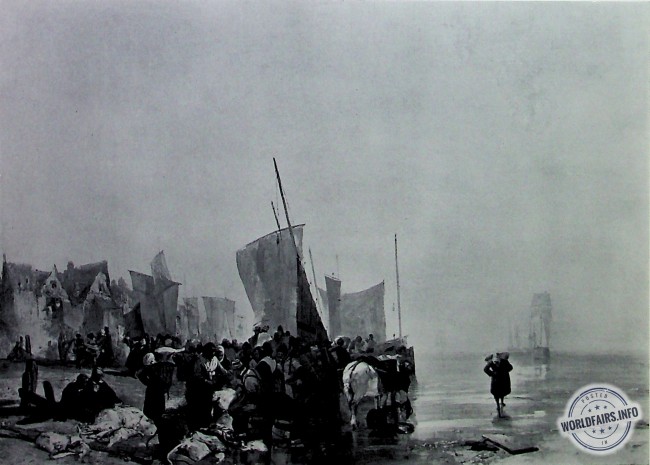
The Fish Market, Boulogne.<br />In the collection of Sir Charles Tennant. - By R. P. Bonington
The Fish Market, Boulogne.
In the collection of Sir Charles Tennant. - By R. P. Bonington

On attending Bonington's funeral. Sir Thomas Lawrence wrote of him:—“I have never known in my own time an early death of talent so promising, and so rapidly and obviously improving.” This was high praise from the most prominent and most triumphant portrait painter of his day, for this Sir Thomas undoubtedly was, a distinction earned by his dexterous touch and by his courtly manners and bearing.

A portrait of Miss Croker, lent by Mr. Pierpont Morgan, is that of the niece and adopted daughter of John Wilson Croker, the politician and essayist, who was born in 1780, and died in 1857. He was the friend of the Prince of Wales (George IV.), who was so fond of children that “ Nony," by which pet name the King always called Miss Croker, was never absent from the children’s balls at the Palace. Miss Croker married Sir George Barrow, and inspired one of Sir Thomas's finest portraits, of which a mezzotint engraving was published in 1828.

SIR THOMAS LAWRENCE was born on May 4, 1769, at Bristol. He early distinguished himself by his ability in drawing. His father was landlord of the Black Bear Inn, Devizes; and the first efforts of the young painter which attracted notice were some portraits in chalk of his father's customers. At the early age of ten years he set up as a portrait painter in crayons at Oxford; but he soon afterwards ventured to take a house at Bath, where he immediately met with much employment and extraordinary success. In his seventeenth year he commenced oil painting; in 1787, twelve months afterwards, he settled in London, and entered himself as a student in the Royal Academy. His success in London was as great as it had been in the provinces. In 1791, though under the age required by the rules, he was elected an Associate of the Academy, and after the death of Sir Joshua Reynolds in the following year he succeeded him as painter to the King, lie painted at this time, in his twenty-third year, the portraits of the King and Queen, which were presented by Lord Macartney to the Emperor of China.

Miss Croker.<br />In the collection of J. Pierpont Morgan, Esq. - By Sir Thomas Lawrence, P. R. A
Miss Croker.
In the collection of J. Pierpont Morgan, Esq. - By Sir Thomas Lawrence, P. R. A

In 1794 he was elected a Royal Academician ; he was knighted by the Prince Regent in 1815, and at the death of West, in 1820, he was unanimously elected President of the Academy. From the time of his election as a member of the Academy to his death, Sir Thomas’s career as a successful portrait painter was unrivalled, and he contributed, from 1787 to 1830 inclusive, 311 pictures to the exhibitions of the Royal Academy. He died in London, at his house in Russell Square, on January 7, 1830. He was never married. Shortly after his death a selection of ninety-one of his works was exhibited at the British Institution.

The Waterloo Gallery at Windsor remains a noble monument of Sir Thomas Lawrence's skill as a portrait painter. The pictures of the Emperor Francis, of Pius VII., and of the Cardinal Gonsalvi, m that collection, are among the masterpieces of the art of portraiture. These pictures were painted on the Continent in the years 1818-19. He excelled chiefly' in the portraits of ladies and children. He was a member of the Academy of St. Luke at Rome, and of many other foreign academies, and in 1825 he was created a Chevalier of the Legion d'Honneur.

There is but one portrait by Reynolds in this room, that of Lady Caroline Price, a daughter of Viscount Carlingford. She married, in 1774, Uvedale Price, who was afterwards created a baronet. She died in 1826. This splendid picture represents Lad3- Caroline against a crimson background. She is dressed in a closely-fitting black satin habit with large buttons, and wears a white fichu round her neck. It has been engraved by John Jones, S. W. Reynolds, and A. W. Saunders, and is the property of Mr. J. Wernher.

Lady Caroline Price.<br />In the collection of J. Wernher, Esq. - By Sir Joshua Reynolds, P. R. A.
Lady Caroline Price.
In the collection of J. Wernher, Esq. - By Sir Joshua Reynolds, P. R. A.

There was also but a single canvas by Hogarth, but that was the celebrated picture "The Lady’s Last Stake,” or, as it was formerly called, “ Picquet, or Virtue in Danger,” painted in 1759. Hogarth himself thus alludes to it:-"An amiable nobleman (Lord Charlemont) requested that before I made a final adieu to the pencil I should paint him one picture, the subject to be my own choice, and the reward whatever I demanded. The story I pitched upon was a young and virtuous married lady, who, by playing cards with an officer, loses her money, watch, and jewels; the moment when he offers them back in return for her honour, and she is wavering at his suit, was my point of time.” It is supposed that Mrs. Thrale sat for the portrait of the heroine. The picture was lent by Mr. J. Pierpont Morgan, and it is said to be Hogarth's chief work outside the public galleries.

Hogarth, the father of the modern British School, stands unrivalled as a caricaturist and moralist. Under him English Art began to reflect the life of the times. “The turn of his mind was dramatic and satirical, and he took therefore to drawing, for the delight of society, its deformities and its weaknesses. He possessed an intense power of invention and expression in domestic drama.”

WILLIAM HOGARTH was born on November 10, 1697, in London, according to the register of births, at Great St. Bartholomew’s, West Smithfield, in Bartholomew Close, “next doore to Mr. Dowinge’s the printer's," and was baptised in the still existent font of the church, “ye 28th Nov. 1697." His father, a native of Westmoreland, and originaly a schoolmaster, was employed in London as a corrector of the press. He spelt his name Hogart. Hogarth was apprenticed at an early age to Mr. Ellis Gamble, who kept a silversmith's shop in Cranbourn Alley, and he was bred an engraver of crests and ciphers on silver and other metal plates. This occupation, however, does not appear to have suited his taste, and at the expiration of his apprenticeship, in 1718, he turned his attention to engraving on copper for booksellers.

The Lady's Last Stake<br />In the collection of J. Pierpont Morgan, Esq. - By W. Hogarth
The Lady's Last Stake
In the collection of J. Pierpont Morgan, Esq. - By W. Hogarth

When Sir James Thornhill founded his academy for painting in Great Queen Street, Lincoln's Inn Fields, with Sir Godfrey Kneller as governor, William Hogarth was one of his first pupils. In the year 1730 he married the only daughter of Sir James Thornhill, against that painter’s consent. He engraved many book plates at this period, but lie derived little benefit from the employment, sometimes receiving for his plates scarcely more than the value of the copper. He therefore set up as a portrait painter, in which occupation he met with considerable success for a time. It was in 1731, during the early stage of his career as a painter, that he painted his series of "The Harlot’s Progress,” which was immediately followed by “The Rake’s Progress,” engraved in 1735. He acquired still greater fame by his series of “ Marriage a la Mode," engraved in 1745. Hogarth was now an artist of high repute, both as a painter and satirist. His own likeness at the National Gallery is a good specimen of his skill as a portrait painter, while the “ Marriage a la Mode " and such pictures as “The Lady’s Last Stake” show him at once as a moralist and an artist of consummate ability. In 1757 Hogarth was appointed Sergeant Painter to the King in the place of Mr. Thornhill, son of Sir James Thornhill, who had resigned. He died at his house in Leicester Fields on October 26, 1764, aged 67, and was buried in a vault at Chiswick, where he generally resided in the summer.

Mrs. Raikes, whose portrait by Romney was lent by Mr. Leopold Flirsch, was the daughter of the Hon. Henry Finch, and married in 1774 Mr. Thomas Raikes, Governor of the Bank of England. She is represented with powdered hair, dressed in white with large ruffle and black sash, and seated at a spinet. The- background is formed by a landscape and red curtain.

Mrs. Raikes<br />In the collection of Leopold Hirsch, Esq. - By George Romney.
Mrs. Raikes
In the collection of Leopold Hirsch, Esq. - By George Romney.

The Long Gallery contained two superb pictures by Morland. This artist's works were at one time better known abroad than those of any other British painter, and it is thought by some that he inspired such men as Bastien Lepage and J. F. Millet, as our Constable and Bonington inspired Corot and Daubigny. One of the two above-mentioned works, “ Playing at Soldiers,” was painted for Dean Markham, of York, and was engraved by G. Keating in 1788. The other, “ Robbing the Orchard,” was engraved by Scott. Both were lent by Sir Charles Tennant.


GEORGE MORLAND was the son of Henry Robert Morland, a portrait painter in crayons and an engraver in mezzotint. He was born on June 26, 1763, and was instructed in his art by his father; his subjects were generally animals or domestic scenes, and all his pictures are executed with extreme facility.
Morland died on October 29, 1804, in a sponging house in Eyre Street, Coldbath Fields, in his forty-first year. His death was hastened by dissipation. He married the sister of William Ward.

Morland exhibited upwards of forty pictures at the Royal Academy between 1779 and 1804. The pictures varied much in their subjects; one, exhibited in 1779, is called in the catalogue “A Drawing with a Poker”; the last, in 1804, is termed “A Landscape, with Hounds in Full Chase." The “Inside of a Stable,” exhibited in 1791, and regarded b}' several writers as his masterpiece, is now in the National Gallery.

“Elizabeth Howard, Duchess of Rutland,” by Hoppner, was the daughter of Frederick, fifth Earl of Carlisle, and married, in 1799, John Henry, fifth Duke of Rutland. She died in 1825. This beautiful picture was lent by Mr. W. H. Lever.

Robbing the Orchard.<br />In the collection of Sir Charles Tennant. - By George Morland.
Robbing the Orchard.
In the collection of Sir Charles Tennant. - By George Morland.

Playing at Soldiers.<br />In the collection of Sir Charles Tennant. - By George Morland.
Playing at Soldiers.
In the collection of Sir Charles Tennant. - By George Morland.

Elizabeth Howard, Duchess of Rutland.<br />In the collection of W. H. Lever, Esq. - By J. Hoppner, R. A.
Elizabeth Howard, Duchess of Rutland.
In the collection of W. H. Lever, Esq. - By J. Hoppner, R. A.

It has been said that the chief glory of the English school of painting is its treatment of landscape. Its founder was Wilson, though he worked under foreign influence. “The first man who struck out a more distinctly English line in landscape—English in subject and realistic in treatment—was Gainsborough, and from Gainsborough the succession is direct to Constable, whose influence upon both the English and Erench schools of landscape was very great.”

Constable’s “White Horse," or, as it was previously called, “A Scene on the River Stour," is probably the work to which the artist owed his admission to the Royal Academy. It somewhat resembles “ The Hay Wain" in the National Gallery, a picture painted to a large extent with a palette knife. It was produced in 1819, and is in the collection of Mr. J. Pierpont Morgan, by whom it was lent.

C. R. Leslie, R.A., in his life of the painter, says :—“'The White Horse,’ on many accounts the most important picture Constable ever painted, and certainly one of the finest, is now in the possession of L. Archer Burton, Esq., of The Woodlands, Hants. At a late period of the painter’s life he calls it ‘one of my happiest efforts on a large scale, being a placid representation of a serene grey morning.’ Nobody has painted with more truth the finest English summer weather, as depicted in ‘The White Horse.’ There is a place among our painters which Turner left unoccupied, and which neither Wilson, Gainsborough, Cozens, nor Girtin so completely filled as John Constable. He was the most genuine painter of English cultivated scenery, leaving untouched its mountains and lakes.”

The White Horse.<br />In the collection of J. Pierpont Morgan, Esq. - By John Constable, R. A.
The White Horse.
In the collection of J. Pierpont Morgan, Esq. - By John Constable, R. A.

“A Lock on the Stour,” or “Opening the Lock,” is another landscape by which Constable was represented in this gallery. A river is flowing towards the lock gates, which a boy is opening, and below the lock is a sailing-boat fastened to a post. In the distance are meadows, with the spire of Dedham Church. This picture was lent by Sir Charles Tennant.

JOHN CONSTABLE was born at East Bergholt, in Suffolk, in 1776. His father intended him for the business of a miller, but Constable’s taste for landscape painting developed itself early, and he resolved to be a painter. He became a student of the Royal Academy in 1S00, received some instruction in landscape painting from R. R. Reinagle, R.A., and was much encouraged by Sir George Beaumont. In 1816 he married, and from 1820 he resided at Hampstead, the beautiful neighbourhood of which chiefly occupied his pencil for the remainder of his life. He was elected a member of the Royal Academy in 1829, having been an associate for ten years, and he exhibited altogether 104 works at the Academy. He died in London on March 30, 1837.

Constable’s landscapes are conspicuous for the simplicity of their subjects, consisting generally of a cottage, a village church, or green, or a simple meadow, and some are distinguished for the effect of dew or rain. “ I love," said Constable, “ every stile, and stump, and lane in the village ; as long as I am able to hold a brush 1 shall never cease to paint them.”

A Lock on the Stour, or Opening the Lock.<br />In the collection of Sir Charles Tennant. - By John Constable, R. A.
A Lock on the Stour, or Opening the Lock.
In the collection of Sir Charles Tennant. - By John Constable, R. A.

At the time when the delicate porcelains of the East began to attract attention in Europe, China closets often became interesting features in our old manor houses. Consequently, the Royal Pavilion had its China Closet furnished with a very choice, though small, collection of English Ceramic Art. Examples of Wedgwood and Worcester were the most prominent in the collection.

Happy in its conception and admirable in its realisation, the Royal Pavilion was the outcome of the best traditions of the country it so well represented, and no Briton could leave it without a feeling of national pride.

“ It is the best and most truly artistic in the whole of the Street of Nations," wrote Mr. Frederic Harrison, “the onl}' one, indeed, that a man of taste can view without a smile or a groan.”

Of the 600,000 visitors who passed through the rooms of the Royal Pavilion, none were more enthusiastic in their praise than French architects and artists, the general consensus of opinion being that, whilst in outward appearance the British Pavilion was refined, reticent, and reposeful, the beautiful interior and the wealth of its art treasures were not surpassed by any of its rivals.

Répondre

Retourner vers « Paris 1900 - Arts, design, mode, spectacles »