Extract of book "The Royal Pavilion - Paris International Exhibition, 1900"
In the Long Gallery

- The Harvest Waggon
In the Collection of Lord Tweedmouth - By Thomas Gainsborough, R. A.
The "Coast Scene, Dragging Nets,” lent by Mr. G. J. Gould, was exhibited at the Gainsborough Exhibition in 1885, and represents fishermen dragging a net to the shore near a rocky bank, on which stands an ancient ruined building with a background of trees. It is one of Gainsborough's finest landscapes, and is admirable in all respects.
Gainsborough's portraits included “ Miss Tyler of Bath.” She was a daughter of Dr. Tyler, rector of Hobden, and an aunt of Robert Southey, the poet, who, in his childhood, lived at Bath in the house of this lady. This charming picture, which has been admirably engraved by H. Robinson, was lent by Lord Iveagh, who also sent his portrait of “ Mrs. Russell," the eldest daughter of Mr. Joseph Cocks. The picture was painted in 1782, and represents her seated in a landscape in a low-necked dress and bodice trimmed with frilling, and a shawl loosely' thrown around her. Her dark hair hangs in curls about her neck.
The portrait of Francisca Danzi, afterwards Mine, le Brun, was first exhibited at the Royal Academy in 1780, and again in 1878. She was a famous singer, and appeared at the Italian Opera in 1777, when she attracted great attention. She became prima donna, and married in 1780. The painting represents her with hair curled and powdered and with a light gauze scarf thrown loosely round her shoulders. This beautiful portrait of a beautiful woman was lent by Mr. Leopold Hirsch.
All these pictures by Gainsborough are admirable examples of his art, and recall Ruskin’s famous saying: “His hand is as light as the sweep of a cloud, as swift as the flash of a sunbeam. In the management and quality of single and particular tints, in the purely' technical part of painting, Turner is a child to Gainsborough."

- Coast Scene : Dragging Nets.
In the collection of Georges J. Gould, Esq. - By Thomas Gainsborough, R. A.
THOMAS GAINSBOROUGH was born at Sudbury, in Suffolk, in the spring of 1727. After evincing, by bis unaided attempts from Nature, a decided talent for landscape painting, he left Sudbury for London when he was fourteen years of age, and became the pupil, first of Gravelot. the engraver, and then of Francis Hayman, at that time a painter of repute, and, like Gainsborough himself, one of the original members of the Royal Academy, which was founded in 1768. Gainsborough set up in Hatton Garden as a portrait and landscape painter, but without success, and, after four years’ residence in the metropolis, he returned to his native place. When still a youth he married Margaret Burr, a young lady of some fortune, and settled in Ipswich. About the first of his pictures to attract notice was a view of Landguard Fort, of which there is a print by Major; the picture has perished. His reputation extending, he settled in 1760 at Bath as a more suitable field for the exercise of his abilities. At Bath much of his time was devoted to portraiture, which appears subsequently to have divided his attention with landscape painting. In 1774 he settled in London, and rented a portion of Schomberg House, Pall Mall; from this period his reputation was such that he was considered the rival of Sir Joshua Reynolds in portrait painting. He was one of the original members of the Royal Academy, and sent 96 pictures to its exhibitions between 1769 and 1783, after which 3'ear he ceased to contribute. He is said to have never put his name to any picture. Gainsborough died in London, on August 2, 1788, and was buried in Kew Churchyard.

- Miss Tyler of Bath.
In the collection of Lord Iveagh. - By Thomas Gainsborough, R. A.
Shortly after Gainsborough’s death, Sir Joshua Reynolds, then President of the Royal Academy, delivered a discourse to the students on the “Character of Gainsborough.’’ In this he alludes to Gainsborough's method of handling—his habit of hatching. “All those odd scratches and marks,” he observes, “which, on a close examination, are so observable in Gainsborough’s pictures, and which, even to experienced painters, appear rather the effect of accident than design—this chaos, this uncouth and shapeless appearance, by a kind of magic, at a certain distance, assume form, and all the parts seem to drop into their proper places, so that we can hardly refuse acknowledging the full effect of diligence, under the appearance of chance and hasty negligence.” He observes, in another place, “whether he most excelled in portraits, landscapes, or fancy pictures it is difficult to determine.”

- Mrs. Russell
In the collection of Lord Iveagh. - By Thomas Gainsborough, R. A.

- Madame le Brun.
In the collection of Leopold Hirsch, Esq. - By Thomas Gainsborough, R. A.
“The Fish Market, Boulogne," represented Bonington, an artist whom the French frequently claim as their own. It is one of the best works by this artist. It shows the sands at early morning; boats are landing fish, and the calm open sea and the numerous figures make a very attractive picture. It has been engraved by Quilley, and is in the possession of Sir Charles Tennant.
RICHARD PARKES BONINGTON was born in the village of Arnold, near Nottingham, on October 25, 1801. His father, who was a landscape and portrait painter, took him when only fifteen years old to Paris, and there procured him permission to copy in the Louvre. Owing to this circumstance Bonington's education was chiefly French ; he became a student of the Ecole des Beaux-Arts, and occasionally attended the studio of Baron Gros. He devoted himself chiefly to landscape painting, working often in water colours; his subjects are mostly marine or river views.
Bonington gained a considerable reputation in Paris, and had a great influence upon the French school of painting. He visited Italy, and in Venice found ample materials suited to his taste. By the exhibition of some of the works which he painted there, both in oil and in water colours, he acquired a great reputation in England also. He died of decline at 29, Tottenham Street, London, on September 23, 1828, shortly after his return from a second visit to Paris, not having quite completed his twenty - seventh year. He was buried in St. James's Church, Pentonville.
Bonington exhibited only four pictures at the Royal Academy: “A Scene on the French Coast,” in 1827; and the three following in 1828: “Henry III. of France," “A Coast Scene," and “The Grand Canal, with the Church of La Vergine della Salute, Venice.”
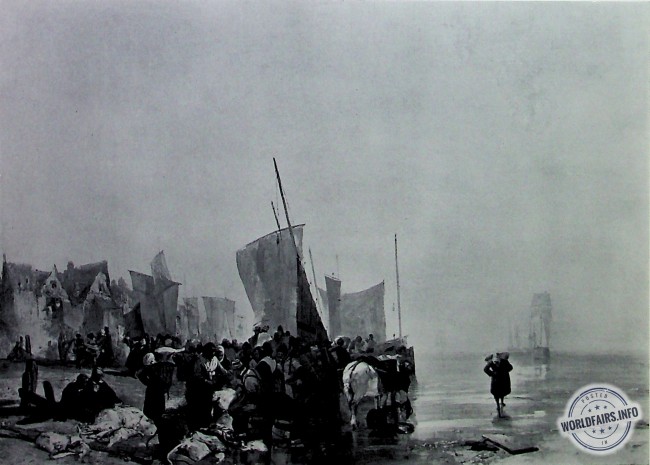
- The Fish Market, Boulogne.
In the collection of Sir Charles Tennant. - By R. P. Bonington
On attending Bonington's funeral. Sir Thomas Lawrence wrote of him:—“I have never known in my own time an early death of talent so promising, and so rapidly and obviously improving.” This was high praise from the most prominent and most triumphant portrait painter of his day, for this Sir Thomas undoubtedly was, a distinction earned by his dexterous touch and by his courtly manners and bearing.
A portrait of Miss Croker, lent by Mr. Pierpont Morgan, is that of the niece and adopted daughter of John Wilson Croker, the politician and essayist, who was born in 1780, and died in 1857. He was the friend of the Prince of Wales (George IV.), who was so fond of children that “ Nony," by which pet name the King always called Miss Croker, was never absent from the children’s balls at the Palace. Miss Croker married Sir George Barrow, and inspired one of Sir Thomas's finest portraits, of which a mezzotint engraving was published in 1828.
SIR THOMAS LAWRENCE was born on May 4, 1769, at Bristol. He early distinguished himself by his ability in drawing. His father was landlord of the Black Bear Inn, Devizes; and the first efforts of the young painter which attracted notice were some portraits in chalk of his father's customers. At the early age of ten years he set up as a portrait painter in crayons at Oxford; but he soon afterwards ventured to take a house at Bath, where he immediately met with much employment and extraordinary success. In his seventeenth year he commenced oil painting; in 1787, twelve months afterwards, he settled in London, and entered himself as a student in the Royal Academy. His success in London was as great as it had been in the provinces. In 1791, though under the age required by the rules, he was elected an Associate of the Academy, and after the death of Sir Joshua Reynolds in the following year he succeeded him as painter to the King, lie painted at this time, in his twenty-third year, the portraits of the King and Queen, which were presented by Lord Macartney to the Emperor of China.

- Miss Croker.
In the collection of J. Pierpont Morgan, Esq. - By Sir Thomas Lawrence, P. R. A
In 1794 he was elected a Royal Academician ; he was knighted by the Prince Regent in 1815, and at the death of West, in 1820, he was unanimously elected President of the Academy. From the time of his election as a member of the Academy to his death, Sir Thomas’s career as a successful portrait painter was unrivalled, and he contributed, from 1787 to 1830 inclusive, 311 pictures to the exhibitions of the Royal Academy. He died in London, at his house in Russell Square, on January 7, 1830. He was never married. Shortly after his death a selection of ninety-one of his works was exhibited at the British Institution.
The Waterloo Gallery at Windsor remains a noble monument of Sir Thomas Lawrence's skill as a portrait painter. The pictures of the Emperor Francis, of Pius VII., and of the Cardinal Gonsalvi, m that collection, are among the masterpieces of the art of portraiture. These pictures were painted on the Continent in the years 1818-19. He excelled chiefly' in the portraits of ladies and children. He was a member of the Academy of St. Luke at Rome, and of many other foreign academies, and in 1825 he was created a Chevalier of the Legion d'Honneur.
There is but one portrait by Reynolds in this room, that of Lady Caroline Price, a daughter of Viscount Carlingford. She married, in 1774, Uvedale Price, who was afterwards created a baronet. She died in 1826. This splendid picture represents Lad3- Caroline against a crimson background. She is dressed in a closely-fitting black satin habit with large buttons, and wears a white fichu round her neck. It has been engraved by John Jones, S. W. Reynolds, and A. W. Saunders, and is the property of Mr. J. Wernher.

- Lady Caroline Price.
In the collection of J. Wernher, Esq. - By Sir Joshua Reynolds, P. R. A.
There was also but a single canvas by Hogarth, but that was the celebrated picture "The Lady’s Last Stake,” or, as it was formerly called, “ Picquet, or Virtue in Danger,” painted in 1759. Hogarth himself thus alludes to it:-"An amiable nobleman (Lord Charlemont) requested that before I made a final adieu to the pencil I should paint him one picture, the subject to be my own choice, and the reward whatever I demanded. The story I pitched upon was a young and virtuous married lady, who, by playing cards with an officer, loses her money, watch, and jewels; the moment when he offers them back in return for her honour, and she is wavering at his suit, was my point of time.” It is supposed that Mrs. Thrale sat for the portrait of the heroine. The picture was lent by Mr. J. Pierpont Morgan, and it is said to be Hogarth's chief work outside the public galleries.
Hogarth, the father of the modern British School, stands unrivalled as a caricaturist and moralist. Under him English Art began to reflect the life of the times. “The turn of his mind was dramatic and satirical, and he took therefore to drawing, for the delight of society, its deformities and its weaknesses. He possessed an intense power of invention and expression in domestic drama.”
WILLIAM HOGARTH was born on November 10, 1697, in London, according to the register of births, at Great St. Bartholomew’s, West Smithfield, in Bartholomew Close, “next doore to Mr. Dowinge’s the printer's," and was baptised in the still existent font of the church, “ye 28th Nov. 1697." His father, a native of Westmoreland, and originaly a schoolmaster, was employed in London as a corrector of the press. He spelt his name Hogart. Hogarth was apprenticed at an early age to Mr. Ellis Gamble, who kept a silversmith's shop in Cranbourn Alley, and he was bred an engraver of crests and ciphers on silver and other metal plates. This occupation, however, does not appear to have suited his taste, and at the expiration of his apprenticeship, in 1718, he turned his attention to engraving on copper for booksellers.

- The Lady's Last Stake
In the collection of J. Pierpont Morgan, Esq. - By W. Hogarth
When Sir James Thornhill founded his academy for painting in Great Queen Street, Lincoln's Inn Fields, with Sir Godfrey Kneller as governor, William Hogarth was one of his first pupils. In the year 1730 he married the only daughter of Sir James Thornhill, against that painter’s consent. He engraved many book plates at this period, but lie derived little benefit from the employment, sometimes receiving for his plates scarcely more than the value of the copper. He therefore set up as a portrait painter, in which occupation he met with considerable success for a time. It was in 1731, during the early stage of his career as a painter, that he painted his series of "The Harlot’s Progress,” which was immediately followed by “The Rake’s Progress,” engraved in 1735. He acquired still greater fame by his series of “ Marriage a la Mode," engraved in 1745. Hogarth was now an artist of high repute, both as a painter and satirist. His own likeness at the National Gallery is a good specimen of his skill as a portrait painter, while the “ Marriage a la Mode " and such pictures as “The Lady’s Last Stake” show him at once as a moralist and an artist of consummate ability. In 1757 Hogarth was appointed Sergeant Painter to the King in the place of Mr. Thornhill, son of Sir James Thornhill, who had resigned. He died at his house in Leicester Fields on October 26, 1764, aged 67, and was buried in a vault at Chiswick, where he generally resided in the summer.
Mrs. Raikes, whose portrait by Romney was lent by Mr. Leopold Flirsch, was the daughter of the Hon. Henry Finch, and married in 1774 Mr. Thomas Raikes, Governor of the Bank of England. She is represented with powdered hair, dressed in white with large ruffle and black sash, and seated at a spinet. The- background is formed by a landscape and red curtain.

- Mrs. Raikes
In the collection of Leopold Hirsch, Esq. - By George Romney.
The Long Gallery contained two superb pictures by Morland. This artist's works were at one time better known abroad than those of any other British painter, and it is thought by some that he inspired such men as Bastien Lepage and J. F. Millet, as our Constable and Bonington inspired Corot and Daubigny. One of the two above-mentioned works, “ Playing at Soldiers,” was painted for Dean Markham, of York, and was engraved by G. Keating in 1788. The other, “ Robbing the Orchard,” was engraved by Scott. Both were lent by Sir Charles Tennant.
GEORGE MORLAND was the son of Henry Robert Morland, a portrait painter in crayons and an engraver in mezzotint. He was born on June 26, 1763, and was instructed in his art by his father; his subjects were generally animals or domestic scenes, and all his pictures are executed with extreme facility.
Morland died on October 29, 1804, in a sponging house in Eyre Street, Coldbath Fields, in his forty-first year. His death was hastened by dissipation. He married the sister of William Ward.
Morland exhibited upwards of forty pictures at the Royal Academy between 1779 and 1804. The pictures varied much in their subjects; one, exhibited in 1779, is called in the catalogue “A Drawing with a Poker”; the last, in 1804, is termed “A Landscape, with Hounds in Full Chase." The “Inside of a Stable,” exhibited in 1791, and regarded b}' several writers as his masterpiece, is now in the National Gallery.
“Elizabeth Howard, Duchess of Rutland,” by Hoppner, was the daughter of Frederick, fifth Earl of Carlisle, and married, in 1799, John Henry, fifth Duke of Rutland. She died in 1825. This beautiful picture was lent by Mr. W. H. Lever.

- Robbing the Orchard.
In the collection of Sir Charles Tennant. - By George Morland.

- Playing at Soldiers.
In the collection of Sir Charles Tennant. - By George Morland.

- Elizabeth Howard, Duchess of Rutland.
In the collection of W. H. Lever, Esq. - By J. Hoppner, R. A.
It has been said that the chief glory of the English school of painting is its treatment of landscape. Its founder was Wilson, though he worked under foreign influence. “The first man who struck out a more distinctly English line in landscape—English in subject and realistic in treatment—was Gainsborough, and from Gainsborough the succession is direct to Constable, whose influence upon both the English and Erench schools of landscape was very great.”
Constable’s “White Horse," or, as it was previously called, “A Scene on the River Stour," is probably the work to which the artist owed his admission to the Royal Academy. It somewhat resembles “ The Hay Wain" in the National Gallery, a picture painted to a large extent with a palette knife. It was produced in 1819, and is in the collection of Mr. J. Pierpont Morgan, by whom it was lent.
C. R. Leslie, R.A., in his life of the painter, says :—“'The White Horse,’ on many accounts the most important picture Constable ever painted, and certainly one of the finest, is now in the possession of L. Archer Burton, Esq., of The Woodlands, Hants. At a late period of the painter’s life he calls it ‘one of my happiest efforts on a large scale, being a placid representation of a serene grey morning.’ Nobody has painted with more truth the finest English summer weather, as depicted in ‘The White Horse.’ There is a place among our painters which Turner left unoccupied, and which neither Wilson, Gainsborough, Cozens, nor Girtin so completely filled as John Constable. He was the most genuine painter of English cultivated scenery, leaving untouched its mountains and lakes.”

- The White Horse.
In the collection of J. Pierpont Morgan, Esq. - By John Constable, R. A.
“A Lock on the Stour,” or “Opening the Lock,” is another landscape by which Constable was represented in this gallery. A river is flowing towards the lock gates, which a boy is opening, and below the lock is a sailing-boat fastened to a post. In the distance are meadows, with the spire of Dedham Church. This picture was lent by Sir Charles Tennant.
JOHN CONSTABLE was born at East Bergholt, in Suffolk, in 1776. His father intended him for the business of a miller, but Constable’s taste for landscape painting developed itself early, and he resolved to be a painter. He became a student of the Royal Academy in 1S00, received some instruction in landscape painting from R. R. Reinagle, R.A., and was much encouraged by Sir George Beaumont. In 1816 he married, and from 1820 he resided at Hampstead, the beautiful neighbourhood of which chiefly occupied his pencil for the remainder of his life. He was elected a member of the Royal Academy in 1829, having been an associate for ten years, and he exhibited altogether 104 works at the Academy. He died in London on March 30, 1837.
Constable’s landscapes are conspicuous for the simplicity of their subjects, consisting generally of a cottage, a village church, or green, or a simple meadow, and some are distinguished for the effect of dew or rain. “ I love," said Constable, “ every stile, and stump, and lane in the village ; as long as I am able to hold a brush 1 shall never cease to paint them.”

- A Lock on the Stour, or Opening the Lock.
In the collection of Sir Charles Tennant. - By John Constable, R. A.
At the time when the delicate porcelains of the East began to attract attention in Europe, China closets often became interesting features in our old manor houses. Consequently, the Royal Pavilion had its China Closet furnished with a very choice, though small, collection of English Ceramic Art. Examples of Wedgwood and Worcester were the most prominent in the collection.
Happy in its conception and admirable in its realisation, the Royal Pavilion was the outcome of the best traditions of the country it so well represented, and no Briton could leave it without a feeling of national pride.
“ It is the best and most truly artistic in the whole of the Street of Nations," wrote Mr. Frederic Harrison, “the onl}' one, indeed, that a man of taste can view without a smile or a groan.”
Of the 600,000 visitors who passed through the rooms of the Royal Pavilion, none were more enthusiastic in their praise than French architects and artists, the general consensus of opinion being that, whilst in outward appearance the British Pavilion was refined, reticent, and reposeful, the beautiful interior and the wealth of its art treasures were not surpassed by any of its rivals.